The Unique Teacher
The Unique Teacher: The Theology, Iconography, and Soteriology of Lord Dakshinamurty
Abstract This paper explores Dakshinamurty, the manifestation of Lord Shiva as the Primordial Guru (Adi Guru) and the Supreme Teacher of the Universe (Jagadguru). It provides a comprehensive analysis of his etymological roots, the profound semiotics of his iconography, and his central role in Jnana Yoga (the path of wisdom), distinguishing this form from the dynamic aspects of the deity.
1. Introduction: The Primordial Guru
Within the Hindu pantheon, Lord Dakshinamurty holds a distinct and exalted station. Unlike deities commonly invoked for protection (raksha) or material prosperity (lakshmi), Dakshinamurty is sought exclusively for the summum bonum of human existence: Moksha (liberation) attained through Jnana (self-knowledge).
As an aspect of Shiva, the dissolver in the Hindu Trinity, Dakshinamurty represents a subtle shift in the concept of “destruction.” Here, he does not destroy the physical cosmos or the body; rather, he incinerates the darkness of ignorance (avidya) that veils the true nature of the Self. He is the static, silent center of the universe, contrasting sharply with the dynamic, dancing form of Nataraja. He is the Adi Guru, the original source from whom all lineages of wisdom, arts, and sciences flow, encompassing the Vedas, music, and yoga.
1.1 Etymology and Cosmic Direction
The appellation Dakshinamurty yields two distinct yet complementary interpretations, each enriching the devotee:
The South-Facing Form (Dakshina + Murti): In Vastu Shastra and traditional Hindu cosmology, the South is the direction presided over by Yama, the Lord of Death and Time. It is generally considered an inauspicious direction for prayer. However, Shiva, as the conqueror of death (Mrityunjaya), sits facing South. By doing so, he looks directly at mortality and the cycle of time (Samsara), symbolically conquering them. The devotees, sitting at his feet, face North—the direction of spiritual ascent—thereby turning their backs on death and gazing toward immortality (Amritatva).
The Skillful, Formless One (Dakshina + Amurti): The Sanskrit root Dakshina also denotes “skill,” “competency,” or “power.” Amurti means “formless.” This interpretation suggests that the Ultimate Reality is formless (Nirguna Brahman), beyond name and shape. Yet, out of infinite compassion, this Formless Reality “skillfully” assumes a manifest form to interact with and guide the aspirant. It highlights the paradox of the Infinite becoming accessible to the finite.
^2
2. Iconography: A Visual Scripture
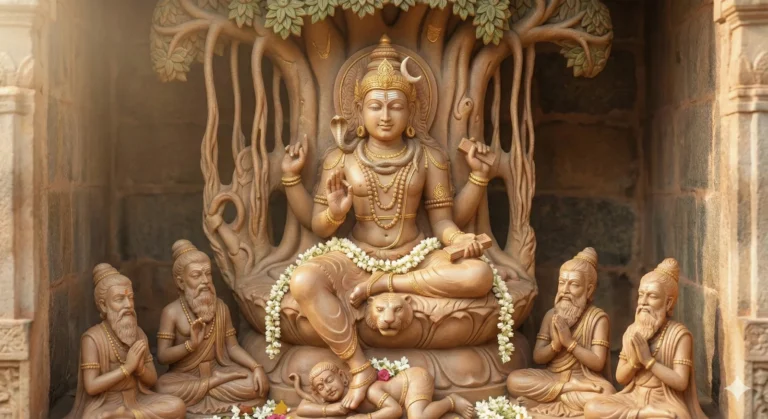
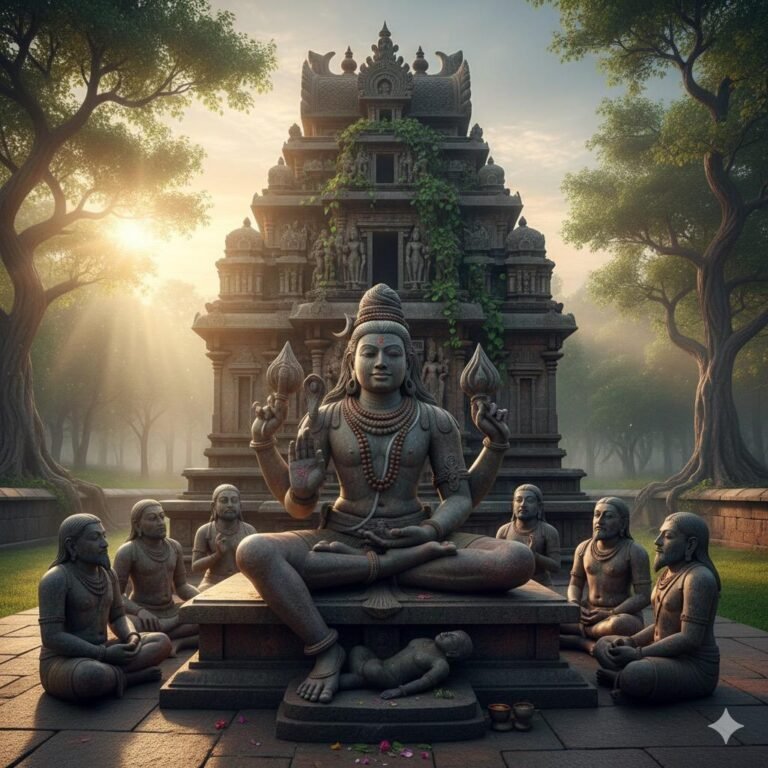
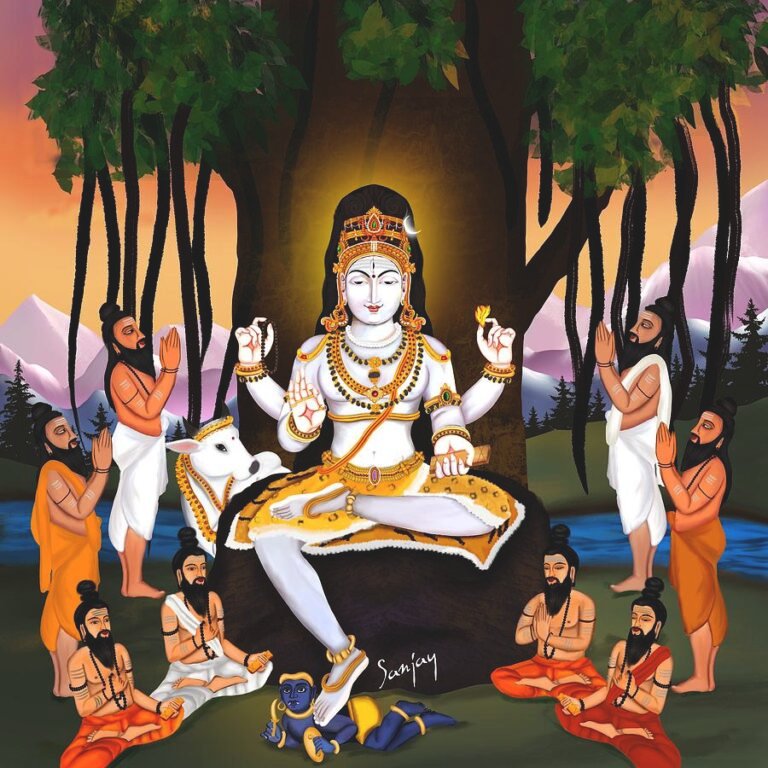
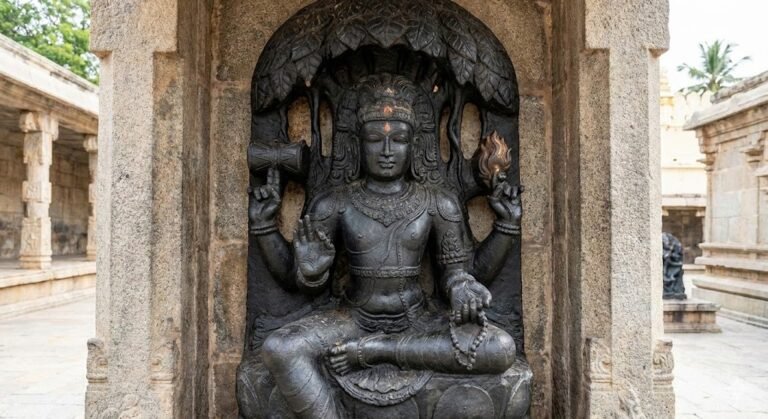
The image of Dakshinamurty is not merely a mythological portrait but a visual scripture—a dense collection of symbols that codify the principles of Advaita Vedanta (Non-Dualism). Every ornament and gesture instructs the viewer on the nature of Reality.
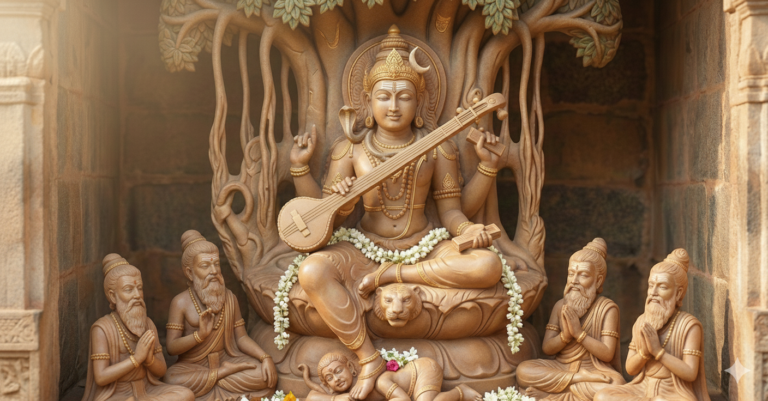
The Banyan Tree (Vata Vriksha): He is invariably seated beneath a Banyan tree. This tree is significant for its vast shade and its unique ability to grow aerial roots that support the main branches, allowing it to expand indefinitely. It symbolizes Sanatana Dharma (Eternal Truth), which is ever-expanding and self-supporting. Just as the tree provides sanctuary from the scorching sun, the Guru offers the cool shade of wisdom to protect the soul from the burning heat of cyclic existence (Samsara).
The Age Paradox: A striking feature of this iconography is the inversion of age norms. The verse “Chitram vatataror mule vriddha shishya gurur yuva” notes the wonder of a youthful teacher instructing elderly disciples.
The Guru (Youthful): Represents the Truth, which is beyond time (Kaalatita). Truth never ages; it is perennially fresh.
The Disciples (Elderly): The four sages (Sanaka, Sanandana, Sanatana, and Sanatkumara) represent the human intellect. The mind may be “old” with experience, logic, and bookish learning, yet it remains unillumined and weary without the spark of direct intuitive realization.
^3
The Chin Mudra (The Gesture of Consciousness): His right hand is held in a specific gesture that serves as the central glyph of the entire composition.
The Thumb: Represents Brahman (God/The Absolute), which stands apart and supports the rest.
The Index Finger: Represents the Jiva (Individual Soul).
The Three Separated Fingers: Represent the three Malas (impurities) that separate the soul from God: Avidya (Ignorance), Karma (Action/Reaction), and Maya (Illusion).
The Union: When the index finger bends away from the three impurities to touch the base of the thumb, it forms a circle—a symbol of perfection and unity (Yoga). This signifies the Jivatma-Paramatma Aikyam (the oneness of the individual and the supreme).
Subjugation of Apasmara: Dakshinamurty’s right foot rests firmly on the back of a dwarf-demon named Apasmara Purusha.
Apasmara translates to “loss of memory” or “forgetfulness”—specifically, the forgetfulness of one’s divine nature.
Crucially, the demon is suppressed, not killed. This signifies that ignorance is not annihilated—for duality is required for the cosmic play to exist—but is rendered dormant by the weight of wisdom. The symbolism serves as a warning: one must remain vigilant, or the suppressed ignorance may rise again.
^4
2.1 Diagram: The Semiotics of Dakshinamurty
graph TD A[Lord Dakshinamurty] –> B(Direction: South) A –> D(Hand Gesture: Chin Mudra) A –> E(Under Foot: Apasmara) A –> F(Environment: Banyan Tree)
B –> B1[Conquering Death / Yama] B –> B2[Bestowing Immortality]
D –> D1[Thumb: Brahman] D –> D2[Index: Jiva] D –> D3[Union: Non-Dual Reality]
E –> E1[Apasmara = Forgetfulness of Self] E –> E2[Suppression of Ignorance]
F –> F1[Eternal Truth / Sanatana Dharma] F –> F2[Shelter from Samsara]
3. Philosophy: Teaching Through Silence
Perhaps the most esoteric aspect of Dakshinamurty is his pedagogical method. He teaches through Mauna (Silence).
“Gurostu mauna vyakhyanam shishyaastu chinna samshayah” (The Guru’s exposition is silence, yet the disciples’ doubts are dispelled.)
This “Silence” is not merely the absence of speech or a lack of words. In Vedantic philosophy, it refers to Para Vak—the transcendental vibration of sound before it differentiates into thought or speech. Language, by nature, categorizes and divides, inevitably fragmenting the non-dual Truth. Consequently, words often distort the very Absolute they attempt to describe. Silence, being the substrate of all sound, is the only medium capable of transmitting the experience of the Infinite. By tuning into this silence, the disciple bypasses the noisy confusion of the intellect and accesses direct intuition.
$$^5$$
4. Soteriology: Why Adopt Him?
Soteriology refers to the doctrine of salvation. In the context of Bhakti (devotion), why would a modern seeker choose Dakshinamurty over other forms?
Transformation of Vision: Conventional prayer often seeks to manipulate external circumstances (e.g., physical healing, wealth accumulation). Worship of Dakshinamurty, conversely, demands a transmutation of internal vision. It is the path for those who realize that lasting peace comes not from arranging the world to suit the ego, but from understanding the true nature of the Self.
The Universal Teacher: For those who do not have a living, physical Guru, Dakshinamurty serves as the eternal, accessible Teacher. Invoking him aligns the seeker’s intellect with the cosmic intelligence (Hiranyagarbha).
Resolution of Duality: His worship bridges the gap between Bhakti (devotion to a form) and Jnana (knowledge of the formless). He is the Saguna (form) gateway that leads the devotee to the Nirguna (formless) Absolute.
5. Conclusion
Dakshinamurty is not merely a mythological figure but the personification of the inward turn of consciousness toward Self-Realization. He represents the ultimate clarity that arises when the mind becomes still. He is the Silent Teacher who eternally reminds us that the wisdom we seek is not found in the external world, but is already seated within the lotus of our own hearts, waiting to be discovered beneath the noise of our own thoughts.
References
Primary Scripture: Sri Dakshinamurty Stotram by Adi Shankaracharya.
Upanishad: Dakshinamurty Upanishad (Krishna Yajurveda), detailing the Mantra and Yantra worship.
Academic Study: Hirst, J. G. Suthren. Shankara’s Advaita Vedanta: A Way of Teaching. Routledge, 2005. (Provides context on the pedagogical methods of Advaita).
Iconography: The Greatness of Shiva: Mahimnastava of Pushpadanta, edited by Arthur Avalon (Sir John Woodroffe).
$$^1$$
: Rao, T.A. Gopinatha. Elements of Hindu Iconography, Vol 2 Part 1. p. 273.
$$^2$$
: Swami Dayananda Saraswati. Sri Dakshinamurti Stotram. Arsha Vidya Gurukulam.
$$^3$$
: Dakshinamurty Stotram, Dhyana Shloka 1.
$$^4$$
: Kramrisch, Stella. The Presence of Siva. Princeton University Press.
$$^5$$
: Dakshinamurty Stotram, Dhyana Shloka 2.