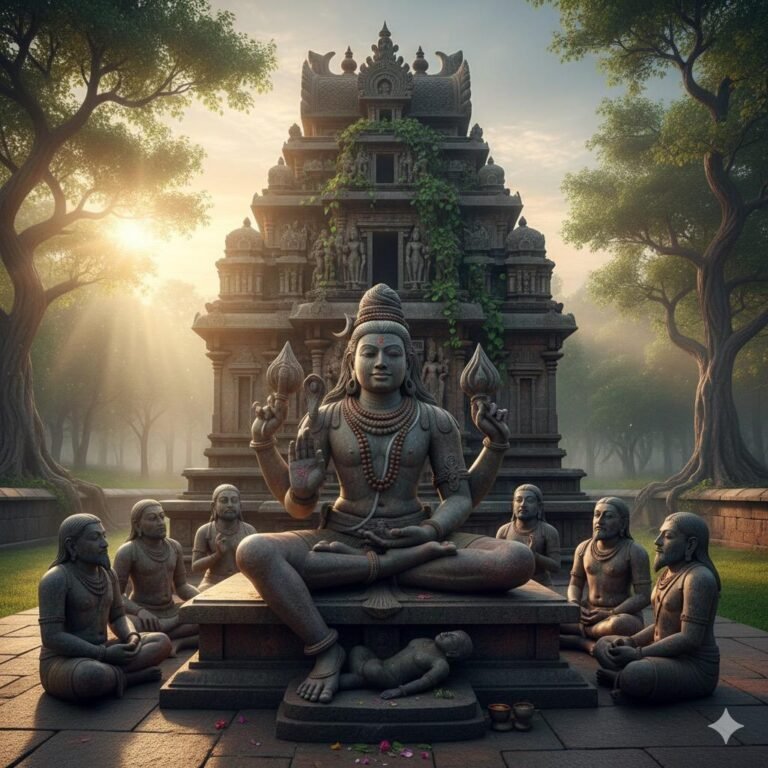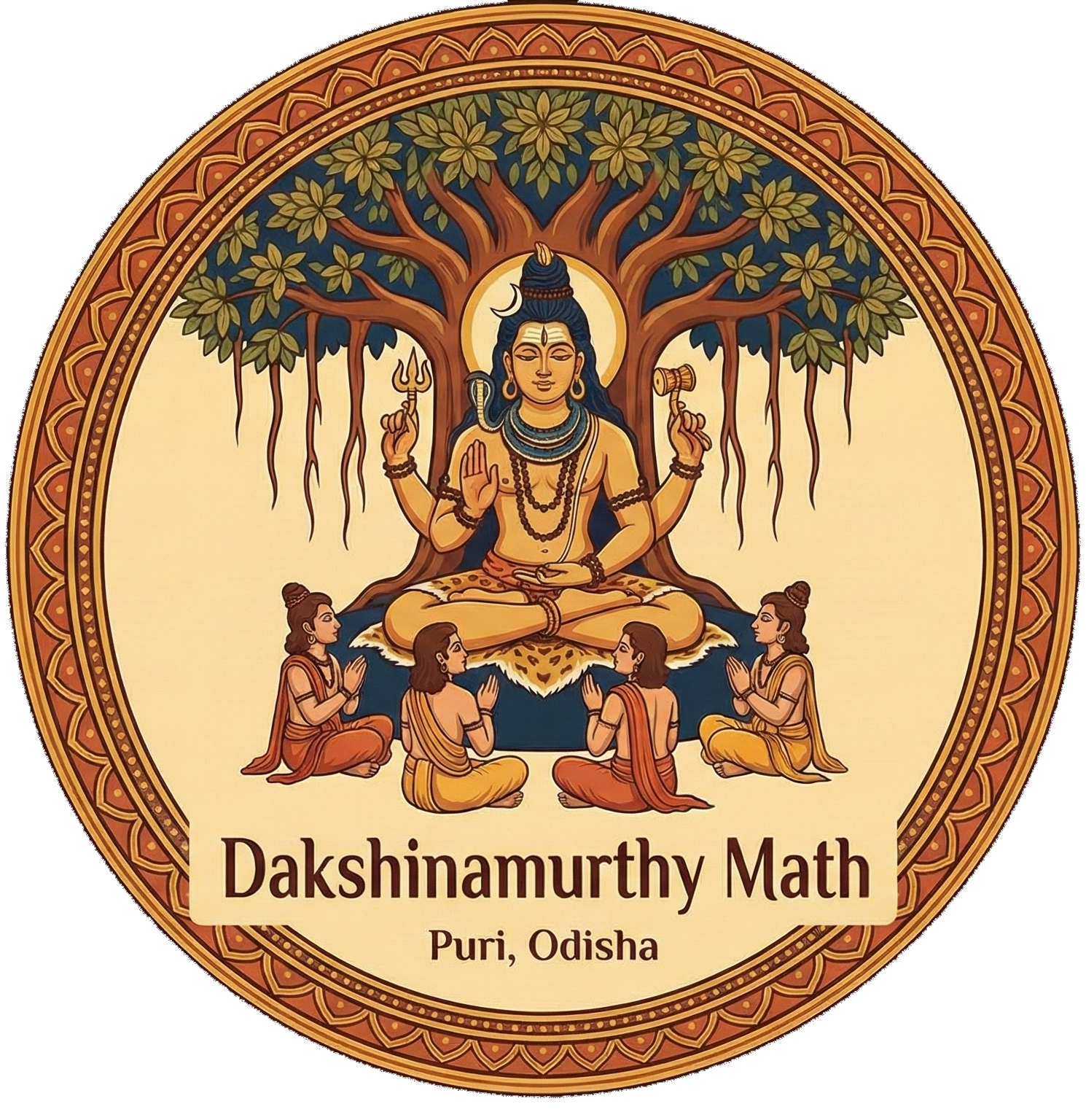
Abstract In the pantheon of Hindu deities, Dakshinamurty (Dakṣiṇāmūrti) occupies a unique position as the personification of supreme awareness, understanding, and knowledge. An aspect of Lord Shiva, he is the Adi Guru (primordial teacher) who imparts the highest spiritual wisdom not through words, but through profound silence. This essay explores the theological significance, iconography, and philosophical underpinnings of Dakshinamurty as the ultimate source of Jnana (knowledge), drawing upon the Dakshinamurty Stotram of Adi Shankaracharya and relevant Upanishadic texts.
1. Introduction: The Manifestation of Wisdom
Dakshinamurty is the form of Shiva as the universal teacher of yoga, music, wisdom, and the Shastras.[^1] Unlike the dynamic Nataraja (Lord of Dance) or the fierce Bhairava, Dakshinamurty is a static, serene figure, representing the cessation of mental modifications (chitta-vritti-nirodha) which is the prerequisite for true knowledge. He is worshipped as the god of wisdom and meditation, typically enshrined in the southern niche of Shiva temples, facing south.[^2]
2. Etymology and Orientation
The name Dakshinamurty is derived from two Sanskrit words: Dakṣiṇa and Mūrti.
- The Directional Meaning: Dakṣiṇa means “South.” In Hindu cosmology, the south is the direction of Death (Yama). By facing south, Shiva symbolically faces death and ignorance to transcend them. He serves as a beacon of immortality (amritatva) for those bound by the cycle of birth and death.[^3]
- The Competence Meaning: Dakṣiṇya also implies “skill,” “competence,” or “grace.” Thus, Dakshinamurty is the “Benevolent Form” or the “Skillful One” who can liberate the devotee from the bonds of ignorance through the grace of knowledge.[^4]
3. Iconography: The Visual Language of Gnosis
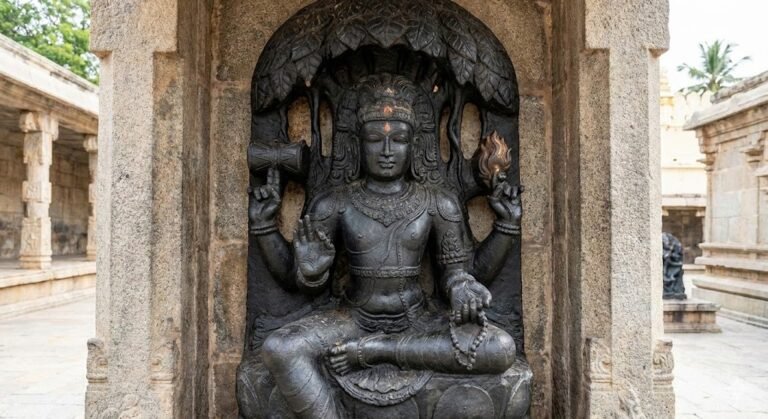
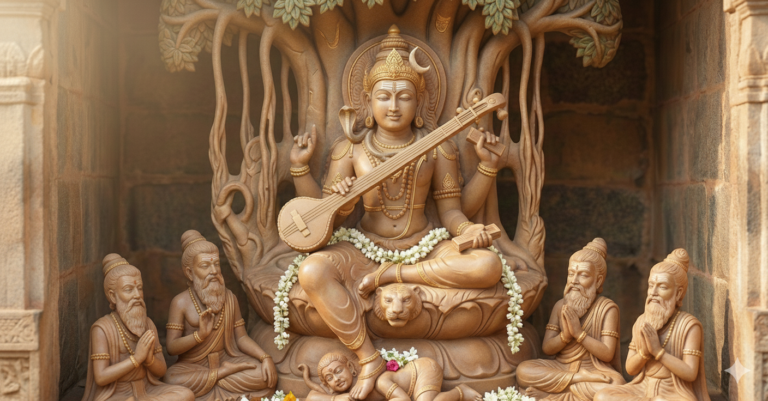
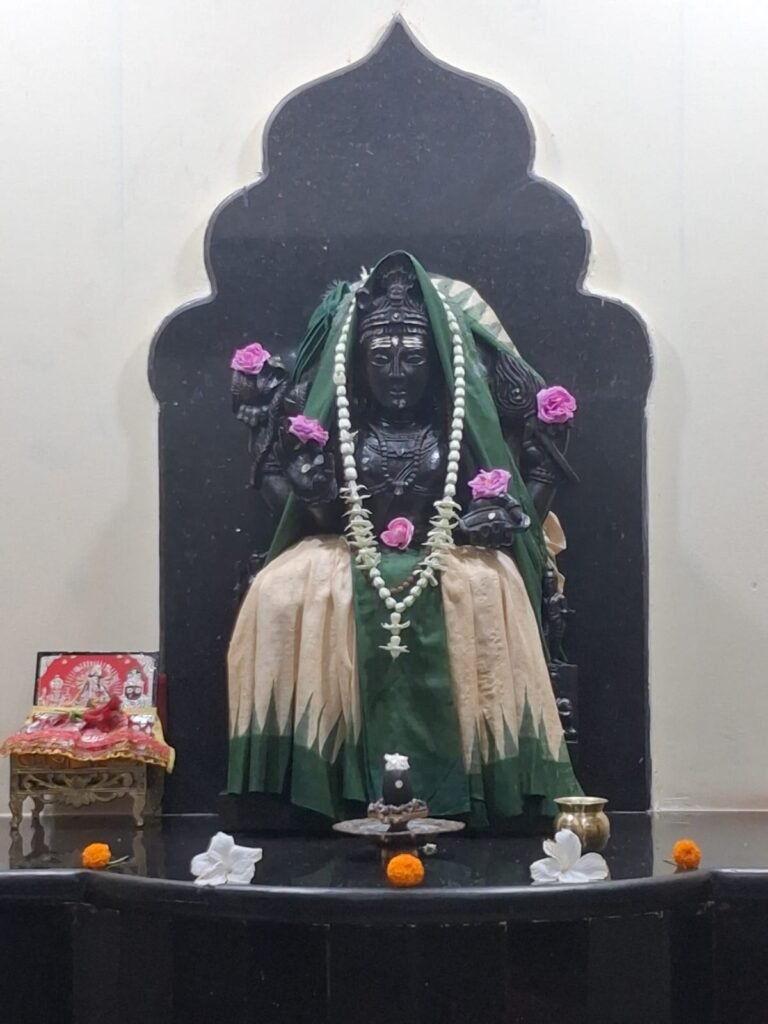
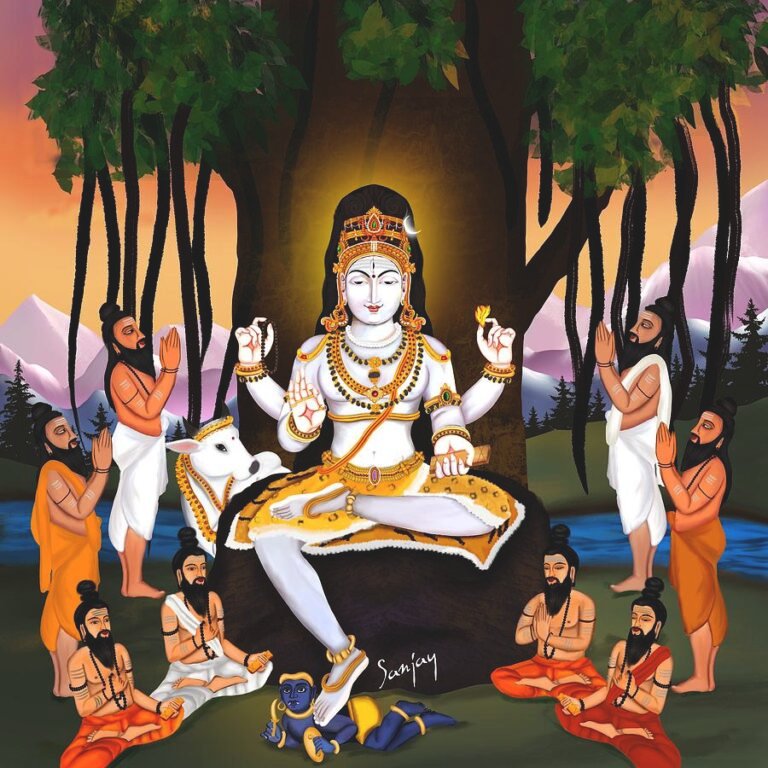
The iconography of Dakshinamurty is a dense interplay of symbols, where every element serves as a pedagogical tool for the seeker of knowledge.
3.1. The Banyan Tree (Vata Vriksha)
Dakshinamurty is invariably depicted seated under a Banyan tree. The Banyan tree, with its aerial roots and expansive canopy, symbolizes the eternal universe and the cyclic nature of existence (Samsara). Just as the massive tree resides potentially within a tiny seed, the entire cosmos resides within the Self (Atman). This metaphor is central to the Dakshinamurty Stotram.[^5]
3.2. The Chin Mudra (Jnana Mudra)
Perhaps the most significant attribute is the hand gesture known as the Chin Mudra or Jnana Mudra. The tip of the thumb touches the tip of the index finger, forming a circle, while the other three fingers remain separated and extended.
- The Thumb: Represents Brahman (the Absolute Reality), which is the support for all else.
- The Index Finger: Represents the Jiva (individual soul).
- The Three Fingers: Represent the three impurities (malas) or the three gunas (Satva, Rajas, Tamas) that separate the soul from God.[^6] The contact between the index finger and the thumb symbolizes the unification of the individual soul with the Absolute, achieved when the impurities are transcended.
3.3. Apasmara Purusha
His right foot rests firmly on a dwarf demon known as Apasmara Purusha. This figure personifies ignorance (Avidya) and ego (Ahamkara). By trampling Apasmara, Dakshinamurty demonstrates that true knowledge is grounded in the suppression of ignorance. Unlike other demons who are killed, Apasmara is merely suppressed; ignorance remains a potentiality that must be constantly kept in check by the weight of wisdom.[^7]
4. The Pedagogy of Silence (Mauna Vyakhya)
A distinctive feature of Dakshinamurty’s teaching is that it is non-verbal. The Dakshinamurty Stotram describes him as a “youthful guru” teaching “elderly disciples” (the four Kumaras: Sanaka, Sanandana, Sanatana, and Sanatkumara) through silence.[^8]
Gurostu mauna vyakhyanam shishyastu chhinna samshayah > “The Guru’s exposition is silence, yet the disciples’ doubts are dispelled.”
This silence is not merely the absence of speech but the presence of a profound realization that transcends language. It suggests that the Ultimate Truth (Brahman) is beyond words (anirvachaniya) and can only be realized through direct experience (aparoksha anubhuti).
5. Philosophical Foundations: The Mirror Analogy
Adi Shankaracharya’s Dakshinamurty Stotram encapsulates the essence of Advaita Vedanta (Non-dualism). The hymn opens with the famous “World as a Mirror” analogy:
Vishvam darpana drishyamana nagari tulyam nijantargatam > “The universe is like a city reflected in a mirror, seen within oneself but appearing as if outside due to Maya.”[^9]
Here, Dakshinamurty is identified not just as a deity, but as the Atman (Self) itself. The source of knowledge is not external books or teachers, but the light of one’s own consciousness, which illuminates the world. The Dakshinamurty Upanishad further elaborates that meditating on this form leads to the realization that “I am He” (Soham), dissolving the duality between the knower and the known.[^10]
6. Conclusion
Dakshinamurty represents the synthesis of the Guru, the God, and the Self. He is the archetypal source of knowledge who reminds the seeker that wisdom is not an accumulation of facts, but the removal of ignorance. Through his silent gaze, the “South-Facing Lord” guides humanity from the darkness of Avidya to the light of self-realization, proving that the ultimate source of knowledge is the silence within.
References & Footnotes
[^1]: Rao, T.A. Gopinatha. Elements of Hindu Iconography. Vol. 2, Part 1. Madras: Law Printing House, 1916, pp. 273-274. [^2]: Kramrisch, Stella. The Presence of Siva. Princeton University Press, 1981, p. 427. [^3]: “Dakshinamurti – The World Teacher.” About Shaivism. https://www.allsaivism.com/articles/dakshina.aspx. Accessed 28 Nov. 2025. [^4]: “Dakshinamurthy: The Pinnacle of Jnana.” Anaadi Foundation. https://www.anaadi.org/post/dakshinamurthy-the-pinnacle-of-jana. [^5]: Subrahmanyam, K. The Hymn to Dakshinamurthy. Chinmaya Mission, 2013, Commentary on Verse 2 (Bijasyantarivankuro). [^6]: “Symbol that inspires jnana.” The Hindu, 21 Oct. 2016. https://www.thehindu.com/features/friday-review/religion/Symbol-that-inspires-jnana/article16077656.ece. [^7]: Dallapiccola, Anna L. Dictionary of Hindu Lore and Legend. Thames & Hudson, 2002. Entry: Apasmara. [^8]: Dakshinamurty Stotram, Verse 12 (Mauna vyakhya prakatita…). See: Warrier, Dr. A.G. Krishna. Dakshinamurti Stotra of Sri Sankaracharya. Sri Ramakrishna Math. [^9]: Dakshinamurty Stotram, Verse 1. [^10]: Dakshinamurti Upanishad. Translated by P.R. Ramachander. Verse 5.